Monday, June 11, 2012

Bear Swamp Part II - Pretty Yellow Ones

 [First year male Kentucky Warbler, Bear Swamp, Cumberland County, NJ, Sunday, June 10 2012. That's the hand of Mike Crewe, of CMBO, holding the bird.]

You stare long at the camera and flash, in the dull light of 5:00 a.m. and a long hike with a lot of gear ahead, and they seem heavy and you decide, "No."

That's the best recipe I know to create great photo opportunities, which explains why the shots here are iPhone-camera specials. But how fine it is to sit in a swamp and hear the birds sing, especially when they are Kentucky Warblers and Prothonotary Warblers?

Migration may be over, songbird wise, but birds are still moving around. The Protho, for example, disappeared from Bear Swamp last week, yet it (or another) returned to be banded yesterday. The Kentucky (I assume both birds are the same ones we've heard before) had been in the area, and I suspect, since both wound up within a meter of each other in the same net, one of them was chasing the other. Both were first year males, aged by the pointed shape of their tail feathers, left over from juvenile plumage, and molt limits in the wing showing both juvenile and "formative" plumage, telltale signs of a bird hatched last summer. Those are both things you would not notice in the field, but one might detect the gray-and-brown spotted crown of the Kentucky in a perfect view, different from an older male's solid or just gray-flecked crown.

Hah! Perfect view at a Kentucky Warbler. That's a Holy Grail for birders, unless you are willing to enter the Kentucky's swamp habitat with a great deal of patience, or get very, very lucky. I don't count banding views in this equation.

 [First year male Prothonotary Warbler, Bear Swamp, Cumberland County, NJ June 10, 2012.]

[Besides the brighter head and body plumage, male Prothonotaries can be told from females by the tail pattern, with males showing white on five tail feathers to the female's three. The book is Peter Pyle's Identification Guide to North American Birds.]

I've recently noticed a couple other "new" land birds since migration "ended." A Scarlet Tanager singing in the woods at the entrance to Forsythe NWR this morning has not been there recently - a floating male, perhaps, searching for a mate? Tonight there was a White-eyed Vireo at Cox Hall Creek WMA, along the east side, where I haven't had one all spring - same thing?

 [Mike Crewe gave me a thumbnail sketch of south Jersey ferns between net runs Sunday. Left, we have Virginia Chain Fern, with a reddish, stiff, plasticky stem. Right is the most common fern of Bear Swamp, Cinnamon Fern, which always has cinnamon colored fuzz along the base of the stem.]

[More pretty yellow, proof that I planted Prickly Pear Cactus in our Del Haven yard for more than its resistance to browsing by Chesapeake Bay Retrievers. . . ]

Thursday, June 7, 2012

Thoughtful Thursday


“Don't get involved in partial problems, but always take flight to where there is a free view over the whole single great problem, even if this view is still not a clear one.”
- Ludwig Wittgenstein

Monday, June 4, 2012

It's Best in Morning (Right?); and the Tropics North

[Worm-eating Warblers often probe hanging dead leaves for caterpillars and arthropods, but apparently broken off limbs work, too. Belleplain State Forest, NJ, June 2 2012].

Last Saturday I found myself exploring by bicycle at the "crack" of 1:00 p.m., with my daughter and my fiance, peddling the shady, lightly-traveled roads of Belleplain State Forest. Maybe hard rain the night before had something to do with it, but despite the afternoon hour, every bird you want to find in Belleplain was findable and singing, albeit not with the song frequency you get at dawn, but often enough. So, instead of singing every 10 seconds, maybe the Worm-eating Warbler sings every 30 seconds, or even only once a minute. If you go slow enough, like on a bike or on foot, you're still going to hear it, it and the Hooded, Yellow-throated, Blue-winged, Black-and-White and Prothonotary Warblers, Acadian and Great-crested Flycatchers, Summer Tanagers and all the rest. If you're not in a hurry, you can stop, scan, listen, reposition, scan some more, and see them. Especially because later in the day birds get off their high horse of territory maintenance and set about the work of everyday living - collecting nest material, perhaps, or, by early June, feeding young or bathing in a stream. Good chances for observing behavior. Try the afternoon in your local patch, and see what you find.

[Yellow-billed Cuckoo, one of 5 we found in Belleplain Saturday. Note the boldly patterned tail, which is more muted in Black-billed. And, of course, the yellow lower mandible.]

And another thing about later in the day - things that are "cold-blooded" move more, so you have the bonus of interesting "herps" (short for herptiles, which means reptiles and amphibians) and insects in the afternoon that hide from the dawn chill. Cold-blooded should be put in quotes because what these things really are is ectothermic - they get their heat from outside their bodies, but do quite the good job of it by basking, and can warm up and be as active as a mammal or bird.

[Five-lined Skink gleaming like a tropical creature, Belleplain on Saturday.]

[Male Ebony Jewelwing, right, a damselfly, and its mate, on Poison Ivy near the Sunset Bridge in Belleplain on Saturday.]

All this - the active neotropical migrant birds, colorful herps and insects, warm and humid air, reminds me that the mid-Atlantic in summer is not so different from the famously diverse and wonderful tropics. Hek, Worm-eating Warblers winter mainly on both slopes of Central America, and Yellow-billed Cuckoos substantially farther south than that. Might as well call the eastern forest the tropics north, and so let it be said that the mid-Atlantic forest should be known famously as diverse and wonderful.

And just after I go and think that, literally the very evening after our Belleplain outing I open Mark Garland's Watching Nature and read, "I don't recall when the connection first became clear to me, but slowly the parallels developed in my mind: In summer, our eastern deciduous forest has a distinctly tropical flavor. Many elements of the tropical rainforest's incredible complexity could be seen right in my backyard."

You pegged it, buddy. I suppose this is as good a place as any to mention that Mark and I will be leading a tour next year, not to the tropics but to very special Big Bend National Park and environs in West Texas next April. More info on that tour will appear hear soon.

[Eastern Painted Turtle egg-laying along a sand road in Belleplain. June is egg-laying month for all sorts of turtles - e.g. also Diamond-backed Terrapins along salt marsh causeways - so please drive with great caution, and help your neighborhood turtles across the street, always in the direction they were traveling when you spotted them.]

Another thing about afternoon is that the light can develop these fabulous warm tones, and creatures at the edge of the sea remain as active, or more so, as they were in early morning. So Sunday afternoon we wandered down to Cape May Point State Park for the first time in a good long while, to check on the terns and beach-nesters.

[The sound of a ripping sheet, "aaaarcchh" or something like that, alerted us to this Caspian Tern over Bunker Pond in Cape May Point State Park on Sunday. Just a couple have been around Cape May Point recently. The heavy body, thick, mostly red bill and dark underside to the primaries eliminates Royal Tern, which was also present.]

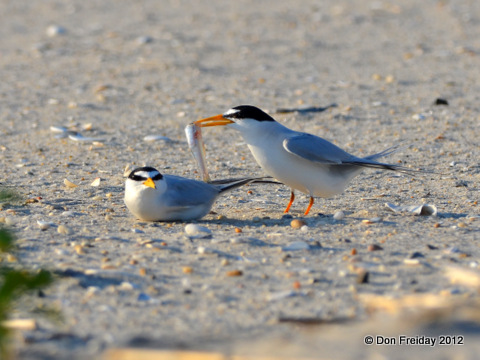
[You've just got to walk the beach at Cape May Point State Park and the South Cape Meadows to enjoy the Least Tern show.]

["Take it, honey, please. . ." "No, I want ice cream!"]

[Fledgling Piping Plover forages between waves along the South Cape May Meadows Beach Sunday evening. How can't you love this bird, which struggles mightily to survive against overwhelming human impacts and disturbance on the coast?]

[Makes you glad you're not the size of a Piping Plover chick - we watched this huge (4") Ghost Crab scuttle across the beach and dune, searching for whatever prey it could find - which would include Piping Plover, if it could catch one. And they sometimes do.]

Saturday, June 2, 2012

Tales from Bear Swamp, Part 1

 [Acadian Flycatcher, Bear Swamp, Cumberland County, NJ, May 28 2012. Caught at our MAPS station. Look how green this bird is compared to the brownish Willow Flycatcher pictured in the May 27 post. Check out also the bolder eyering - though note that the Willow pictured in the post below does show a faint eyering. The Acadian's long wings sticking out well past the tertial feathers  rule out Least and Yellow-bellied Flycatchers as i.d. contenders. This bird's wing chord measured 72 mm, average for Acadian, at the max for Yellow-bellied, and too long for Least. This bird's bill was also too long for YBFL and LEFL, and too wide for "Traill's," the name used for Willow/Alder Flycatchers. Beyond the arcane Empidonax flycatcher i.d. details, this is simply a cool bird - when you're with Acadian Flycatchers, you are in a good place, a rich woods with abundant insects and many birds of interest.]

Quality. That describes Bear Swamp, Cumberland County, NJ, where we've run a MAPS banding station the past few years. Birders know Bear Swamp best from birding the area along Route 555 out of Dividing Creek, where Prothonotary, Yellow-throated, and Kentucky Warblers, Acadian Flycatcher, and Summer Tanager are sought after targets. We burrow deep into the swamp for banding, amongst the ticks and flies and quality forest-interior birds.

As part of the MAPS data collection process, we keep a record of all birds we detect at the station, whether we band them or not, and last weekend had two Barred Owls and a persistently calling, probably breeding Broad-winged Hawk. More quality.

Recaptures of banded birds are an important piece of the MAPS equation. Perhaps the most important reason to operate a fixed-effort banding station during breeding season is to evaluate survival and reproduction, and about 1/3 of our birds are recaptures, including for example the Red-eyed Vireo pictured at the bottom of this post. An amazing thought in and of itself - here's this bird, that we banded one summer, that migrated to somewhere in the Western Amazon, spent the winter, and returned here to breed again. Successfully, from the looks of things.

[Quality - What birder hasn't thrilled to the lovely and unique head pattern of a Worm-eating Warbler? As a birder, I love them not in the hand but perched on a branch, singing their steady trill. As a researcher, I want to know how Worm-eating Warblers are doing, how long they're living, how many young they are producing.]

 [Above and below, female Red-eyed Vireo, Bear Swamp, NJ, May 28, 2012. Male and female red-eyeds are the same, plumage-wise, but the fully developed brood patch gives this female's sex away. The pinkish-yellowish triangle at the top of her breast is her furcular hollow full of fat - she's in good condition to incubate and raise a family. The brood patch is shrouded with feathers when you see birds in the field; here we're blowing the feathers out of the way for a look.]